How Often Can a Horse Have a Baby
Horse breeding is reproduction in horses, and particularly the human-directed procedure of selective convenance of animals, particularly purebred horses of a given breed. Planned matings tin be used to produce specifically desired characteristics in domesticated horses. Furthermore, modernistic breeding direction and technologies can increase the rate of conception, a salubrious pregnancy, and successful foaling.
Terminology [edit]
The father of a horse, a stallion, is commonly known as the sire and the female parent, the mare, is chosen the dam. Both are genetically of import, as each parent provides one-half of the genetic makeup of the ensuing offspring, chosen a foal. Contrary to pop misuse, "filly" refers to a immature male equus caballus only; "filly" is a young female. Though many horse owners may simply breed a family mare to a local stallion in order to produce a companion brute, nearly professional breeders use selective breeding to produce individuals of a given phenotype, or breed. Alternatively, a breeder could, using individuals of differing phenotypes, create a new breed with specific characteristics.
A horse is "bred" where information technology is foaled (born). Thus a colt conceived in England but foaled in the United States is regarded as being bred in the U.s.a..[ane] [2] In some cases, most notably in the Thoroughbred breeding industry, American- and Canadian-bred horses may also be described by the state or province in which they are foaled. Some breeds denote the country, or country, where conception took place as the origin of the foal.[3]
Similarly, the "breeder", is the person who owned or leased the mare at the time of foaling. That private may not have had anything to do with the mating of the mare.[one] [4] It is important to review each brood registry's rules to determine which applies to any specific foal.
In the horse breeding industry, the term "half-brother" or "one-half-sister" only describes horses which have the same dam, just different sires.[five] Horses with the same sire but unlike dams are simply said to be "by the same sire", and no sibling relationship is implied.[half dozen] "Full" (or "own") siblings have both the same dam and the aforementioned sire. The terms paternal half-sibling, and maternal half-sibling are also oft used. 3-quarter siblings are horses out of the aforementioned dam, and are by sires that are either half-brothers (i.e. same dam) or who are by the same sire.[7]
Thoroughbreds and Arabians are also classified through the "distaff" or straight female line, known as their "family" or "tail female person" line, tracing back to their taproot foundation bloodstock or the beginning of their respective stud books. The female line of descent ever appears at the bottom of a tabulated full-blooded and is therefore ofttimes known as the bottom line.[7] In addition, the maternal grandfather of a equus caballus has a special term: damsire.
"Linebreeding" technically is the duplication of quaternary generation or more distant ancestors.[half-dozen] However, the term is often used more loosely, describing horses with duplication of ancestors closer than the fourth generation. It too is sometimes used as a euphemism for the practice of inbreeding, a exercise that is by and large frowned upon by equus caballus breeders, though used by some in an attempt to fix certain traits.
Estrous cycle of the mare [edit]

Stallion checking a mare in estrus. The mare welcomes the stallion by lowering her rear and lifting her tail.
The estrous bicycle (also spelled oestrous) controls when a mare is sexually receptive toward a stallion, and helps to physically prepare the mare for conception. It generally occurs during the bound and summer months, although some mares may exist sexually receptive into the late fall, and is controlled past the photoperiod (length of the solar day), the cycle first triggered when the days begin to lengthen. The estrous cycle lasts almost 19–22 days, with the boilerplate being 21 days. As the days shorten, the mare returns to a catamenia when she is not sexually receptive, known as anestrus. Anestrus – occurring in the majority of, just not all, mares – prevents the mare from conceiving in the winter months, as that would effect in her foaling during the harshest part of the yr, a time when it would be most difficult for the foal to survive.
This cycle contains ii phases:
- Oestrus, or Follicular, stage: five–vii days in length, when the mare is sexually receptive to a stallion. Estrogen is secreted by the follicle. Ovulation occurs in the final 24–48 hours of estrus.
- Diestrus, or Luteal, phase: xiv–fifteen days in length, the mare is non sexually receptive to the stallion. The corpus luteum secretes progesterone.
Depending on breed, on average, sixteen% of mares have double ovulations, allowing them to twin, though this does not touch on the length of time of estrus or diestrus.
Effects on the reproductive organization during the estrous bike [edit]
Changes in hormone levels can accept great furnishings on the physical characteristics of the reproductive organs of the mare, thereby preparing, or preventing, her from conceiving.
- Uterus: increased levels of estrogen during rut cause edema within the uterus, making information technology feel heavier, and the uterus loses its tone. This edema decreases following ovulation, and the muscular tone increases. High levels of progesterone practise not cause edema within the uterus. The uterus becomes flaccid during anestrus.
- Cervix: the cervix starts to relax right before estrus occurs, with maximal relaxation around the fourth dimension of ovulation. The secretions of the cervix increment. Loftier progesterone levels (during diestrus) crusade the cervix to close and become toned.
- Vagina: the portion of the vagina nigh the neck becomes engorged with blood right before estrus. The vagina becomes relaxed and secretions increment.[eight]
- Vulva: relaxes right earlier heat begins. Becomes dry out, and closes more than tightly, during diestrus.[9]
Hormones involved in the estrous wheel, during foaling, and later on birth [edit]
The cycle is controlled by several hormones which regulate the estrous cycle, the mare's behavior, and the reproductive organisation of the mare. The bike begins when the increased solar day length causes the pineal gland to reduce the levels of melatonin, thereby allowing the hypothalamus to secrete GnRH.
- GnRH (Gonadotropin releasing hormone): secreted past the hypothalamus, causes the pituitary to release two gonadotrophins: LH and FSH.
- LH (Luteinizing hormone): levels are highest 2 days following ovulation, and so slowly subtract over 4–5 days, dipping to their everyman levels 5–sixteen days after ovulation. Stimulates maturation of the follicle, which and then in turn secretes estrogen. Dissimilar most mammals, the mare does not accept an increase of LH right before ovulation.
- FSH (Follicle-stimulating hormone): secreted by the pituitary, causes the ovarian follicle to develop. Levels of FSH rise slightly at the end of estrus, but have their highest peak about ten days before the next ovulation. FSH is inhibited past inhibin (run across below), at the same fourth dimension LH and estrogen levels rise, which prevents immature follicles from continuing their growth. Mares may however have multiple FSH waves during a single estrous cycle, and diestrus follicles resulting from a diestrus FSH wave are non uncommon, particularly in the peak of the natural breeding flavor.
- Estrogen: secreted by the developing follicle, it causes the pituitary gland to secrete more LH (therefore, these two hormones are in a positive feedback loop). Additionally, information technology causes behavioral changes in the mare, making her more receptive toward the stallion, and causes physical changes in the cervix, uterus, and vagina to set the mare for conception (see higher up). Estrogen peaks i–ii days before ovulation, and decreases inside ii days following ovulation.
- Inhibin: secreted by the developed follicle right before ovulation, "turns off" FSH, which is no longer needed at present that the follicle is larger.
- Progesterone: prevents formulation and decreases sexual receptibility of the mare to the stallion. Progesterone is therefore lowest during the estrus stage, and increases during diestrus. It decreases 12–fifteen days after ovulation, when the corpus luteum begins to decrease in size.
- Prostaglandin: secreted by the endrometrium 13–15 days post-obit ovulation, causes luteolysis and prevents the corpus luteum from secreting progesterone
- eCG – equine chorionic gonadotropin – also chosen PMSG (pregnant mare serum gonadotropin): chorionic gonadotropins secreted if the mare conceives. First secreted by the endometrial cups around the 36th day of gestation, peaking around twenty-four hour period 60, and decreasing later on about 120 days of gestation. Too help to stimulate the growth of the fetal gonads.
- Prolactin: stimulates lactation
- Oxytocin: stimulates the uterus to contract
Breeding and gestation [edit]
While horses in the wild mate and foal in mid to late leap, in the example of horses domestically bred for competitive purposes, especially horse racing, it is desirable that they be born as close to January i in the northern hemisphere or August 1 in the southern hemisphere as possible,[x] so as to be at an advantage in size and maturity when competing against other horses in the same age group. When an early foal is desired, barn managers will put the mare "under lights" by keeping the barn lights on in the wintertime to simulate a longer day, thus bringing the mare into estrus sooner than she would in nature. Mares signal oestrus and ovulation by urination in the presence of a stallion, raising the tail and revealing the vulva. A stallion, budgeted with a high head, volition usually nicker, nip and nudge the mare, as well as sniff her urine to determine her readiness for mating.
One time fertilized, the oocyte (egg) remains in the oviduct for approximately 5.5 more than days, and so descends into the uterus. The initial single cell combination is already dividing and past the fourth dimension of entry into the uterus, the egg might have already reached the blastocyst stage.
The gestation period lasts for about xi months, or about 340 days (normal average range 320–370 days). During the early on days of pregnancy, the conceptus is mobile, moving about in the uterus until about day 16 when "fixation" occurs. Shortly later on fixation, the embryo proper (and so called up to about 35 days) will go visible on trans-rectal ultrasound (about day 21) and a heartbeat should be visible past about 24-hour interval 23. Afterwards the formation of the endometrial cups and early placentation is initiated (35–40 days of gestation) the terminology changes, and the embryo is referred to as a fetus. True implantation – invasion into the endometrium of whatever sort – does non occur until about day 35 of pregnancy with the formation of the endometrial cups, and true placentation (formation of the placenta) is not initiated until nearly solar day forty-45 and not completed until nearly 140 days of pregnancy. The fetus's sexual activity tin be determined by solar day seventy of the gestation using ultrasound. Halfway through gestation the fetus is the size of between a rabbit and a beagle. The most dramatic fetal development occurs in the last 3 months of pregnancy when 60% of fetal growth occurs.
Colts are carried on average about 4 days longer than fillies.[11]
Care of the pregnant mare [edit]
Domestic mares receive specific care and nutrition to ensure that they and their foals are healthy. Mares are given vaccinations against diseases such every bit the Rhinopneumonitis (EHV-ane) virus (which tin can cause miscarriage) too as vaccines for other conditions that may occur in a given region of the world. Pre-foaling vaccines are recommended 4–half dozen weeks prior to foaling to maximize the immunoglobulin content of the colostrum in the start milk.[12] Mares are dewormed a few weeks prior to foaling, equally the mare is the primary source of parasites for the foal.[13]
Mares can exist used for riding or driving during near of their pregnancy. Practise is healthy, though should be moderated when a mare is heavily in foal.[14] Exercise in excessively high temperatures has been suggested every bit being detrimental to pregnancy maintenance during the embryonic flow;[xv] however ambience temperatures encountered during the research were in the region of 100 degrees F and the aforementioned results may not be encountered in regions with lower ambient temperatures.[ original enquiry? ]
During the outset several months of pregnancy, the nutritional requirements do non increase significantly since the rate of growth of the fetus is very slow. Still, during this time, the mare may be provided supplemental vitamins and minerals, specially if forage quality is questionable. During the last three–four months of gestation, rapid growth of the fetus increases the mare's nutritional requirements. Energy requirements during these last few months, and during the first few months of lactation are similar to those of a equus caballus in full training. Trace minerals such as copper are extremely important, peculiarly during the tenth month of pregnancy, for proper skeletal formation.[16] Many feeds designed for pregnant and lactating mares provide the careful balance required of increased protein, increased calories through extra fat likewise as vitamins and minerals. Overfeeding the pregnant mare, specially during early gestation, should be avoided, equally excess weight may contribute to difficulties foaling or fetal/foal related issues.
Foaling [edit]
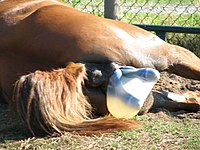
A mare in the early stages of labor
Mares due to foal are usually separated from other horses, both for the do good of the mare and the safety of the soon-to-exist-delivered foal. In improver, separation allows the mare to be monitored more closely by humans for any issues that may occur while giving nascency. In the northern hemisphere, a special foaling stall that is large and clutter complimentary is ofttimes used, especially past major convenance farms. Originally, this was due in part to a need for protection from the harsh wintertime climate nowadays when mares foal early in the year, but fifty-fifty in moderate climates, such as Florida, foaling stalls are still common because they let closer monitoring of mares. Smaller breeders often employ a small pen with a large shed for foaling, or they may remove a wall betwixt two box stalls in a modest barn to make a large stall. In the milder climates seen in much of the southern hemisphere, most mares foal outside, ofttimes in a paddock[17] [18] built specifically for foaling, especially on the larger stud farms.[xix] Many stud farms worldwide employ applied science to alarm human managers when the mare is about to foal, including webcams, closed-circuit television, or contrasted types of devices that alert a handler via a remote alarm when a mare lies down in a position to foal.
On the other mitt, some breeders, specially those in remote areas or with extremely large numbers of horses, may allow mares to foal out in a field amongst a herd, only may too see college rates of foal and mare bloodshed in doing so.
Nigh mares foal at dark or early in the forenoon, and prefer to give nativity alone when possible. Labor is rapid, often no more than than xxx minutes, and from the time the anxiety of the foal appear to full delivery is often only almost 15 to xx minutes. One time the foal is born, the mare volition lick the newborn foal to clean it and help blood circulation. In a very short time, the foal will attempt to stand up and get milk from its mother. A foal should stand and nurse within the offset 60 minutes of life.
To create a bond with her foal, the mare licks and nuzzles the foal, enabling her to distinguish the foal from others. Some mares are aggressive when protecting their foals, and may assail other horses or unfamiliar humans that come up well-nigh their newborns.
After birth, a foal's navel is dipped in antiseptic to prevent infection. The foal is sometimes given an enema to help clear the meconium from its digestive tract. The newborn is monitored to ensure that it stands and nurses without difficulty. While most horse births happen without complications, many owners take kickoff assistance supplies prepared and a veterinarian on telephone call in case of a birthing emergency. People who supervise foaling should likewise watch the mare to be sure that she passes the placenta in a timely way, and that it is consummate with no fragments remaining in the uterus. Retained fetal membranes can cause a serious inflammatory condition (endometritis) and/or infection. If the placenta is not removed from the stall after it is passed, a mare will oftentimes eat it, an instinct from the wild, where blood would attract predators.
Foal care [edit]

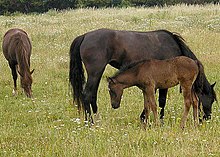
A foal with its mother, or dam
Foals develop rapidly, and within a few hours a wild foal can travel with the herd. In domestic convenance, the foal and dam are usually separated from the herd for a while, but inside a few weeks are typically pastured with the other horses. A foal will brainstorm to consume hay, grass and grain alongside the mare at about 4 weeks old; past 10–12 weeks the foal requires more diet than the mare's milk tin can supply. Foals are typically weaned at iv–8 months of age, although in the wild a foal may nurse for a year.
How breeds develop [edit]
Across the appearance and conformation of a specific type of equus caballus, breeders aspire to improve physical performance abilities. This concept, known as matching "form to role," has led to the development of not only different breeds, just also families or bloodlines inside breeds that are specialists for excelling at specific tasks.
For example, the Arabian horse of the desert naturally adult speed and endurance to travel long distances and survive in a harsh environs, and domestication by humans added a trainable disposition to the animal's natural abilities. In the concurrently, in northern Europe, the locally adjusted heavy horse with a thick, warm glaze was domesticated and put to work as a subcontract fauna that could pull a plow or wagon. This animal was later adapted through selective breeding to create a potent but rideable animal suitable for the heavily armored knight in warfare.
Then, centuries later, when people in Europe wanted faster horses than could be produced from local horses through simple selective breeding, they imported Arabians and other oriental horses to breed every bit an outcross to the heavier, local animals. This led to the development of breeds such as the Thoroughbred, a horse taller than the Arabian and faster over the distances of a few miles required of a European race horse or light cavalry horse. Another cross between oriental and European horses produced the Andalusian, a equus caballus adult in Spain that was powerfully built, but extremely nimble and capable of the quick bursts of speed over short distances necessary for sure types of combat equally well as for tasks such as bullfighting.
Later, the people who settled America needed a hardy horse that was capable of working with cattle. Thus, Arabians and Thoroughbreds were crossed on Spanish horses, both domesticated animals descended from those brought over by the Conquistadors, and feral horses such as the Mustangs, descended from the Spanish horse, but adapted by natural selection to the ecology and climate of the west. These crosses ultimately produced new breeds such as the American Quarter Horse and the Criollo of Argentina. In Canada, the Canadian Equus caballus descended from the French stock Louis Xiv sent to Canada in the late 17th century.[six] The initial shipment, in 1665, consisted of ii stallions and twenty mares from the Purple Stables in Normandy and Brittany, the centre of French horse convenance.[vii] Only 12 of the 20 mares survived the trip. 2 more shipments followed, one in 1667 of fourteen horses (mostly mares, but with at least one stallion), and one in 1670 of 11 mares and a stallion. The shipments included a mix of draft horses and lite horses, the latter of which included both pacing and trotting horses.[1] The exact origins of all the horses are unknown, although the shipments probably included Bretons, Normans, Arabians, Andalusians and Barbs.
In modernistic times, these breeds themselves have since been selectively bred to further specialize at certain tasks. One example of this is the American Quarter Horse. Once a general-purpose working ranch horse, different bloodlines now specialize in dissimilar events. For example, larger, heavier animals with a very steady attitude are bred to give competitors an advantage in events such equally team roping, where a horse has to start and stop chop-chop, but likewise must calmly agree a full-grown steer at the end of a rope. On the other hand, for an upshot known as cut, where the horse must separate a cow from a herd and forbid it from rejoining the group, the all-time horses are smaller, quick, alarm, athletic and highly trainable. They must acquire quickly, have conformation that allows quick stops and fast, low turns, and the best competitors take a certain amount of independent mental ability to anticipate and counter the move of a cow, popularly known equally "cow sense."
Some other example is the Thoroughbred. While most representatives of this brood are bred for horse racing, at that place are also specialized bloodlines suitable every bit evidence hunters or evidence jumpers. The hunter must have a tall, smooth build that allows it to trot and canter smoothly and efficiently. Instead of speed, value is placed on appearance and upon giving the equestrian a comfortable ride, with natural jumping ability that shows bascule and good form.
A bear witness jumper, however, is bred less for overall form and more for ability over tall fences, along with speed, telescopic, and agility. This favors a horse with a good galloping stride, powerful hindquarters that tin can change speed or direction easily, plus a good shoulder angle and length of neck. A jumper has a more powerful build than either the hunter or the racehorse.[20]
History of horse breeding [edit]
The history of equus caballus breeding goes dorsum millennia. Though the precise appointment is in dispute, humans could accept domesticated the horse as far back as approximately 4500 BCE. All the same, evidence of planned breeding has a more blurry history. Information technology is well known, for example, that the Romans did breed horses and valued them in their armies, simply footling is known regarding their breeding and husbandry practices: all that remains are statues and artwork. Mankind has enough of equestrian statues of Roman emperors, horses are mentioned in the Odyssey by Homer, and hieroglyphics and paintings left backside by Egyptians tell stories of pharaohs hunting elephants from chariots. About nothing is known of what became of the horses they bred for hippodromes, for warfare, or even for farming.
One of the primeval people known to document the breedings of their horses were the Bedouin of the Middle East, the breeders of the Arabian horse. While information technology is hard to determine how far dorsum the Bedouin passed on full-blooded information via an oral tradition, in that location were written pedigrees of Arabian horses by CE 1330.[21] The Akhal-Teke of West-Fundamental Asia is another breed with roots in ancient times that was likewise bred specifically for war and racing. The nomads of the Mongolian steppes bred horses for several thousand years also, and the Caspian horse is believed to be a very close relative of Ottoman horses from the earliest origins of the Turks in Central Asia.
The types of horse bred varied with civilisation and with the times. The uses to which a horse was put also adamant its qualities, including smooth amblers for riding, fast horses for carrying messengers, heavy horses for plowing and pulling heavy wagons, ponies for hauling cars of ore from mines, packhorses, carriage horses and many others.
Medieval Europe bred large horses specifically for state of war, called destriers. These horses were the ancestors of the dandy heavy horses of today, and their size was preferred non simply because of the weight of the armor, but also because a big horse provided more power for the knight'southward lance. Weighing almost twice as much as a normal riding horse, the destrier was a powerful weapon in battle meant to human activity like a giant battering ram that could quite literally run down men on an enemy line.
On the other hand, during this same time, lighter horses were bred in northern Africa and the Heart East, where a faster, more agile horse was preferred. The lighter horse suited the raids and battles of desert people, allowing them to outmaneuver rather than overpower the enemy. When Middle Eastern warriors and European knights collided in warfare, the heavy knights were frequently outmaneuvered. The Europeans, still, responded by crossing their native breeds with "oriental" blazon horses such equally the Arabian, Barb, and Turkoman horse This cross-convenance led both to a nimbler state of war horse, such equally today'south Andalusian equus caballus, but too created a blazon of horse known as a Courser, a predecessor to the Thoroughbred, which was used every bit a message equus caballus.
During the Renaissance, horses were bred not only for state of war, merely for haute ecole riding, derived from the most athletic movements required of a state of war horse, and pop amid the elite nobility of the time. Breeds such as the Lipizzan and the at present extinct Neapolitan horse were adult from Spanish-bred horses for this purpose, and also became the preferred mounts of cavalry officers, who were derived more often than not from the ranks of the nobility. Information technology was during this time that firearms were adult, then the light cavalry equus caballus, a faster and quicker war horse, was bred for "shoot and run" tactics rather than the shock action as in the Eye Ages. Fine horses normally had a well muscled, curved neck, slender body, and sweeping mane, as the dignity liked to show off their wealth and breeding in paintings of the era.
Afterwards Charles II retook the British throne in 1660, horse racing, which had been banned by Cromwell, was revived. The Thoroughbred was developed 40 years later on, bred to be the ultimate racehorse, through the lines of three foundation Arabian stallions and one Turkish horse.
In the 18th century, James Burnett, Lord Monboddo noted the importance of selecting appropriate parentage to achieve desired outcomes of successive generations. Monboddo worked more broadly in the abstruse thought of species relationships and evolution of species. The Thoroughbred convenance hub in Lexington, Kentucky was developed in the late 18th century, and became a mainstay in American racehorse breeding.
The 17th and 18th centuries saw more of a need for fine railroad vehicle horses in Europe, bringing in the dawn of the warmblood. The warmblood breeds have been uncommonly practiced at adapting to changing times, and from their carriage horse beginnings they easily transitioned during the 20th century into a sport horse type. Today's warmblood breeds, although yet used for competitive driving, are more often seen competing in show jumping or dressage.
The Thoroughbred continues to boss the equus caballus racing globe, although its lines have been more recently used to amend warmblood breeds and to develop sport horses. The French saddle equus caballus is an excellent instance every bit is the Irish Sport Equus caballus, the latter existence an unusual combination betwixt a Thoroughbred and a draft breed.
The American Quarter Horse was developed early in the 18th century, mainly for quarter racing (racing ¼ of a mile). Colonists did not accept racetracks or whatever of the trappings of Europe that the earliest Thoroughbreds had at their disposal, and then instead the owners of Quarter Horses would run their horses on roads that pb through town every bit a form of local entertainment. Every bit the USA expanded West, the breed went with settlers as a farm and ranch animal, and "cow sense" was peculiarly valued: their employ for herding cattle increased on rough, dry terrain that often involved sitting in the saddle for long hours.
However, this did non mean that the original ¼-mile races that colonists held e'er went out of fashion, so today there are 3 types: the stock horse type, the racer, and the more recently evolving sport blazon. The racing type about resembles the effectively-boned ancestors of the first racing Quarter Horses, and the type is withal used for ¼-mile races. The stock horse blazon, used in western events and as a farm and patrol creature is bred for a shorter stride, an ability to stop and turn apace, and an unflappable attitude that remains at-home and focused even in the face of an angry charging steer. The kickoff two are all the same to this solar day bred to take a combination of explosive speed that exceeds the Thoroughbred on short distances clocked as high every bit 55 mph, only they all the same retain the gentle, at-home, and kindly temperament of their ancestors that makes them easily handled.
The Canadian horse's origin corresponds to shipments of French horses, some of which came from Louis Xiv's own stable and nearly likely were Bizarre horses meant to exist gentlemen's mounts. These were ill-suited to farm work and to the hardscrabble life of the New Earth, and then like the Americans, early Canadians crossed their horses with natives escapees. In time they evolved forth like lines as the Quarter Equus caballus to the S as both the United states and Canada spread westward and needed a at-home and tractable horse versatile enough to carry the farmer'south son to school simply still capable of running fast and running hard as a cavalry horse, a stockhorse, or a horse to pull a conestoga wagon.
Other horses from North America retained a hint of their mustang origins past being either derived from stock that Native Americans bred that came in a rainbow of color, similar the Appaloosa and American Paint Horse. with those E of the Mississippi River increasingly bred to impress and mimic the trends of the upper classes of Europe: The Tennessee Walking Equus caballus and Saddlebred were originally plantation horses bred for their gait and comfortable ride in the saddle as a plantation master would survey his vast lands like an English lord.
Horses were needed for heavy typhoon and carriage work until replaced by the automobile, truck, and tractor. After this time, draft and railroad vehicle equus caballus numbers dropped significantly, though light riding horses remained popular for recreational pursuits. Draft horses today are used on a few modest farms, but today are seen mainly for pulling and plowing competitions rather than subcontract work. Heavy harness horses are now used as an outcross with lighter breeds, such equally the Thoroughbred, to produce the modern warmblood breeds popular in sport horse disciplines, particularly at the Olympic level.
Deciding to brood a equus caballus [edit]
Convenance a horse is an try where the owner, particularly of the mare, will unremarkably demand to invest considerable time and money. For this reason, a horse possessor needs to consider several factors, including:
- Does the proposed convenance creature have valuable genetic qualities to pass on?
- Is the proposed breeding fauna in skilful physical wellness, fertile, and able to withstand the rigors of reproduction?
- For what purpose will the foal be used?
- Is in that location a market for the foal if the owner does not wish to keep the foal for its entire life?
- What is the anticipated economical do good, if any, to the owner of the ensuing foal?
- What is the anticipated economic benefit, if whatever, to the owner(s) of the sire and dam or the foal?
- Does the owner of the mare take the expertise to properly manage the mare through gestation and parturition?
- Does the possessor of the potential foal have the expertise to properly manage and railroad train a young fauna one time it is born?
In that location are value judgements involved in because whether an animal is suitable breeding stock, hotly debated past breeders. Additional personal beliefs may come into play when considering a suitable level of care for the mare and ensuing foal, the potential market or utilize for the foal, and other tangible and intangible benefits to the owner.
If the breeding endeavor is intended to brand a profit, at that place are additional market factors to consider, which may vary considerably from year to twelvemonth, from breed to breed, and by region of the world. In many cases, the low end of the market is saturated with horses, and the law of supply and demand thus allows picayune or no profit to be made from breeding unregistered animals or animals of poor quality, even if registered.
The minimum cost of convenance for a mare owner includes the stud fee, and the cost of proper nutrition, direction and veterinary care of the mare throughout gestation, parturition, and care of both mare and foal up to the time of weaning. Veterinary expenses may be higher if specialized reproductive technologies are used or health complications occur.
Making a profit in horse convenance is often hard. While some owners of only a few horses may keep a foal for purely personal enjoyment, many individuals brood horses in hopes of making some money in the procedure.
A rule of thumb is that a foal intended for sale should be worth three times the toll of the stud fee if it were sold at the moment of birth. From birth forward, the costs of intendance and training are added to the value of the foal, with a auction price going upwardly accordingly. If the foal wins awards in some class of contest, that may also enhance the price.
On the other paw, without conscientious idea, foals bred without a potential market for them may wind up being sold at a loss, and in a worst-case scenario, sold for "relieve" value—a euphemism for sale to slaughter as horsemeat.
Therefore, a mare owner must consider their reasons for breeding, asking hard questions of themselves as to whether their motivations are based on either emotion or profit and how realistic those motivations may exist.
Choosing breeding stock [edit]
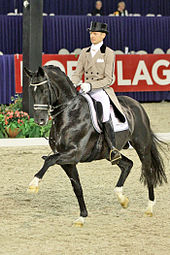
A stallion with a proven competition record is one criterion for being a suitable sire.
The stallion should be chosen to complement the mare, with the goal of producing a foal that has the best qualities of both animals, notwithstanding avoids having the weaker qualities of either parent. Generally, the stallion should have proven himself in the subject field or sport the mare owner wishes for the "career" of the ensuing foal. Mares should also have a competition record showing that they also have suitable traits, though this does not happen as often.
Some breeders consider the quality of the sire to be more than important than the quality of the dam. However, other breeders maintain that the mare is the most important parent. Because stallions can produce far more than offspring than mares, a single stallion can have a greater overall impact on a breed. Nonetheless, the mare may have a greater influence on an individual foal because its physical characteristics influence the developing foal in the womb and the foal also learns habits from its dam when young. Foals may also learn the "language of intimidation and submission" from their dam, and this imprinting may affect the foal'due south status and rank within the herd.[22] [23] Many times, a mature horse will achieve status in a herd similar to that of its dam; the offspring of dominant mares get ascendant themselves.
A purebred horse is usually worth more than than a horse of mixed convenance, though this matters more in some disciplines than others. The brood of the horse is sometimes secondary when breeding for a sport equus caballus, but some disciplines may prefer a certain breed or a specific phenotype of horse. Sometimes, purebred bloodlines are an absolute requirement: For example, about racehorses in the world must be recorded with a breed registry in social club to race.
Bloodlines are frequently considered, as some bloodlines are known to cross well with others. If the parents accept non yet proven themselves by competition or by producing quality offspring, the bloodlines of the horse are often a good indicator of quality and possible strengths and weaknesses. Some bloodlines are known not only for their athletic ability, but could also carry a conformational or genetic defect, poor temperament, or for a medical problem. Some bloodlines are as well fashionable or otherwise marketable, which is an of import consideration should the mare owner wish to sell the foal.
Equus caballus breeders also consider conformation, size and temperament. All of these traits are heritable, and volition determine if the foal will be a success in its chosen field of study. The offspring, or "get", of a stallion are ofttimes fantabulous indicators of his ability to pass on his characteristics, and the particular traits he actually passes on. Some stallions are fantastic performers only never produce offspring of comparable quality. Others sire fillies of groovy abilities merely not colts. At times, a horse of mediocre ability sires foals of outstanding quality.
Mare owners as well look into the question of if the stallion is fertile and has successfully "settled" (i.due east. impregnated) mares. A stallion may not be able to breed naturally, or onetime age may subtract his performance. Mare care boarding fees and semen drove fees can exist a major cost.
[edit]
Convenance a horse tin can be an expensive endeavor, whether breeding a backyard contest horse or the next Olympic medalist. Costs may include:
- The stud and booking fee
- Fees for collecting, treatment, and transporting semen (if AI is used and semen is shipped)
- Mare exams: to make up one's mind if she is salubrious enough to breed, to decide when she ovulates, and (if AI is used) to inseminate her
- Mare transport, care, and board if the mare is bred alive cover at the stallion's residence
- Veterinarian bills to continue the significant mare healthy while in foal
- Possible veterinary bills during pregnancy or foaling should something go wrong
- Veterinary bills for the foal for its first exam a few days following foaling
Stud fees are determined by the quality of the stallion, his performance record, the performance record of his get (offspring), every bit well equally the sport and general market that the fauna is standing for.
The highest stud fees are generally for racing Thoroughbreds, which may accuse from two to three 1000 dollars for a breeding to a new or unproven stallion, to several hundred thousand dollars for a breeding to a proven producer of stakes winners. Stallions in other disciplines often have stud fees that begin in the range of $1,000 to $iii,000, with top contenders who produce champions in certain disciplines able to control as much as $20,000 for 1 breeding. The everyman stud fees to breed to a grade horse or an animal of low-quality pedigree may only exist $100–$200, but there are trade-offs: the horse volition probably be unproven, and likely to produce lower-quality offspring than a horse with a stud fee that is in the typical range for quality breeding stock.[ globalize ]
As a stallion's career, either functioning or convenance, improves, his stud fee tends to increase in proportion. If 1 or 2 offspring are especially successful, winning several stakes races or an Olympic medal, the stud fee volition mostly greatly increase. Younger, unproven stallions will by and large have a lower stud fee earlier on in their careers.
To assist decrease the risk of financial loss should the mare die or abort the foal while meaning, many studs have a live foal guarantee (LFG) – also known as "no foal, free render" or "NFFR" - assuasive the owner to have a costless breeding to their stallion the side by side year. However, this is not offered for every breeding.
Covering the mare [edit]
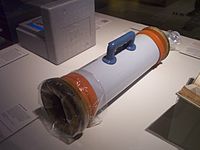
There are two general means to "cover" or brood the mare:
- Live embrace: the mare is brought to the stallion's residence and is covered "live" in the breeding shed. She may also be turned out in a pasture with the stallion for several days to breed naturally ('pasture bred'). The sometime situation is often preferred, equally information technology provides a more than controlled environment, allowing the breeder to ensure that the mare was covered, and places the handlers in a position to remove the horses from one another should one attempt to kicking or bite the other.
- Artificial Insemination (AI): the mare is inseminated past a veterinarian or an equine reproduction manager, using either fresh, cooled or frozen semen.
After the mare is bred or artificially inseminated, she is checked using ultrasound 14–16 days subsequently to see if she "took", and is pregnant. A second check is usually performed at 28 days. If the mare is not significant, she may be bred over again during her next bicycle.
It is considered safe to breed a mare to a stallion of much larger size. Considering of the mare's type of placenta and its attachment and claret supply, the foal will exist limited in its growth inside the uterus to the size of the mare's uterus, but will grow to its genetic potential later it is built-in. Test breedings have been done with typhoon horse stallions bred to small mares with no increase in the number of difficult births.[24]
Alive encompass [edit]
When convenance live cover, the mare is commonly boarded at the stud. She may be "teased" several times with a stallion that will not brood to her, usually with the stallion existence presented to the mare over a barrier. Her reaction to the teaser, whether hostile or passive, is noted. A mare that is in oestrus volition mostly tolerate a teaser (although this is not always the case), and may present herself to him, belongings her tail to the side. A veterinarian may also determine if the mare is gear up to be bred, by ultrasound or palpating daily to determine if ovulation has occurred. Alive cover tin can also be done in freedom on a paddock or on pasture, although due to safety and efficacy concerns, it is not common at professional person breeding farms.
When it has been determined that the mare is ready, both the mare and intended stud volition be cleaned. The mare volition then be presented to the stallion, ordinarily with one handler controlling the mare and one or more handlers in accuse of the stallion. Multiple handlers are preferred, as the mare and stallion tin can be easily separated should there exist whatever trouble.
The Jockey Society, the organization that oversees the Thoroughbred industry in the United States, requires all registered foals to be bred through live cover. Artificial insemination, listed beneath, is not permitted.[25] Similar rules utilise in other countries, such as Commonwealth of australia.[26]
By dissimilarity, the U.S. standardbred industry allows registered foals to be bred by live embrace, or by artificial insemination (AI) with fresh or frozen (not dried) semen. No other bogus fertility handling is allowed. In improver, foals bred via AI of frozen semen may only exist registered if the stallion's sperm was nerveless during his lifetime, and used no subsequently than the calendar year of his death or castration.[27]
Artificial insemination [edit]
Bogus insemination (AI) has several advantages over live comprehend, and has a very similar conception charge per unit:
- The mare and stallion never have to come in contact with each other, which therefore reduces breeding accidents, such as the mare kicking the stallion.
- AI opens upward the world to international breeding, equally semen may be shipped across continents to mares that would otherwise be unable to breed to a particular stallion.
- A mare likewise does non have to travel to the stallion, so the procedure is less stressful on her, and if she already has a foal, the foal does not take to travel.
- AI allows more mares to be bred from 1 stallion, every bit the ejaculate may be split between mares.
- AI reduces the gamble of spreading sexually transmitted diseases between mare and stallion.
- AI allows mares or stallions with wellness issues, such as sore hocks which may forbid a stallion from mounting, to go on to breed.
- Frozen semen may exist stored and used to breed mares even after the stallion is dead, assuasive his lines to keep. However, the semen of some stallions does not freeze well. Some breed registries may not allow the registration of foals resulting from the use of frozen semen after the stallion's death, although other large registries accept such usage and provide registrations. The overall tendency is toward permitting employ of frozen semen subsequently the expiry of the stallion.
A stallion is usually trained to mount a phantom (or dummy) mare, although a alive mare may be used, and he is most usually nerveless using an artificial vagina (AV) which is heated to simulate the vagina of the mare. The AV has a filter and drove area at ane end to capture the semen, which can then be processed in a lab. The semen may be chilled or frozen and shipped to the mare possessor or used to breed mares "on-subcontract". When the mare is in heat, the person inseminating introduces the semen directly into her uterus using a syringe and pipette.
Advanced reproductive techniques [edit]
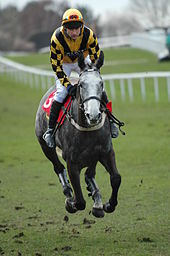
The Thoroughbred industry does non let AI or embryo transplant.
Often an owner does not want to have a valuable contest mare out of training to bear a foal. This presents a problem, as the mare will usually be quite sometime by the fourth dimension she is retired from her competitive career, at which fourth dimension information technology is more difficult to impregnate her. Other times, a mare may take physical bug that forbid or discourage breeding. Yet, at that place are now several options for breeding these mares. These options also permit a mare to produce multiple foals each breeding flavour, instead of the usual one. Therefore, mares may accept an even greater value for breeding.
- Embryo transfer: This relatively new method involves flushing out the mare's fertilized embryo a few days following insemination, and transferring to a surrogate mare, which has been synchronized to be in the same phase of the estrous cycle every bit the donor mare.[28]
- Gamete intrafallopian transfer (GIFT): The mare's ovum and the stallion's sperm are deposited in the oviduct of a surrogate dam. This technique is very useful for subfertile stallions, as fewer sperm are needed, and then a stallion with a low sperm count can still successfully breed.
- Egg transfer: An oocyte is removed from the mare's follicle and transferred into the oviduct of the recipient mare, who is and so bred. This is best for mares with physical problems, such equally an obstructed oviduct, that forbid breeding.
- Intracytoplasmic sperm injection (ICSI): Used in horses due to lack of successful co-incubation of female person and male gametes in simple IVF. A plug of the zona pellucida is removed and a unmarried sperm cell is injected into the ooplasm of the mature oocyte. An advantage of ICSI over IVF is that lower quality sperm can exist used since the sperm does not have to penetrate the zona pellucida. The success charge per unit of ICSI is 23-44% blastocyst development.[29] [thirty]
The world's first cloned equus caballus, Prometea, was built-in in 2003.[31] Other notable instances of equus caballus cloning are:
- In 2006, Scamper, an extremely successful barrel racing horse, a gelding, was cloned. The resulting stallion, Clayton, became the first cloned horse to stand up at stud in the U.S.[32]
- In 2007, a renowned testify jumper and Thoroughbred, Gem Twist, was cloned by Frank Chapot and his family.[33] In September 2008, Gemini was born and several other clones followed, leading to the development of a breeding line from Gem Twist.
- In 2010, the first lived equine cloned of a Criollo horse was born in Argentine republic, and was the beginning horse clone produced in Latin America.[34] In the aforementioned yr a cloned polo horse was sold for $800,000 - the highest known price ever paid for a polo horse.[35]
- In 2013, the world-famous[36] polo star Adolfo Cambiaso helped his high-handicap team La Dolfina win the Argentine National Open, scoring ix goals in the 16-11 match. Two of those he scored atop a horse named Evidence Me, a clone, and the first to ride onto the Argentine pitch.[37] [38]
See likewise [edit]
- Domestication of the horse
- Endometrosis
- Evolution of the horse
- Glossary of equestrian terms
- Pedigree nautical chart
- Thoroughbred breeding theories
References [edit]
- ^ a b Montgomery, East.S, "The Thoroughbred", Arco, New York, 1973 ISBN 0-668-02824-6
- ^ AJC & VRC, "Australian Stud Book", Vol. 31, Ramsay Ware Stockland Pty. Ltd., North Melbourne, 1980
- ^ "Equine Info Commutation - Breeding". www.equineinfoexchange.com . Retrieved 2019-06-11 .
- ^ Stratton, Charles, The International Horseman's Dictionary, Lansdowne Press, Melbourne, 1978, ISBN 0-7018-0590-0
- ^ Summerhayes, RS, Encyclopaedia for Horsemen, Warne & Co, London & New York, 1966
- ^ a b de Bourg, Ross, "The Australian and New Zealand Thoroughbred", Nelson, West Melbourne, 1980, ISBN 0-17-005860-three
- ^ a b Napier, Miles, "Blood Will Tell", JA Allen & Co, London, 1977
- ^ "Nuts of Life". The Horse. 2006-12-01. Retrieved 2019-06-eleven .
- ^ Juan C. Samper (one January 2009). Equine Breeding Direction and Artificial Insemination. Elsevier Health Sciences. ISBN978-1-4160-5234-0.
- ^ The Australian Racing Lath uses August ane as its standard cutoff date, but also uses the date of formulation to make up one's mind age. A foal born on or after July i of a given calendar year is included in the birth cohort of that calendar year if his or her dam was covered no later than August 31 of the previous calendar year. See "Rule AR.46" (PDF). Australian Rules of Racing. 2009-09-29. Retrieved 2010-08-03 .
- ^ Hura, V; et al. (October 1997). "The issue of some factors on gestation length in nonius brood mares in Slovakia (Egyes tényezõk hatása a nóniusz fajta vemhességének idõtartamára)". Proceedings of Roundtable Briefing on Animal Biotechnology. Thirteen . Retrieved 2008-04-22 .
- ^ Inc., Avant-garde Solutions International. "Sign In". www.aaep.org.
- ^ "Expectant Mare: Assuring the Health and Well-Beingness of the Pregnant Mare" Archived 2008-04-fifteen at the Wayback Automobile
- ^ "Equus caballus - convenance". ESDAW . Retrieved 2019-06-xi .
- ^ Mortensen C, Choi YH, Hinrichs M, Ing N, Kraemer D, Vogelsang Due south, Vogelsang Grand. 2006. Effects of exercise on embryo recovery rates and embryo quality in the horse. Animal Repro. Sci. 94:395-397
- ^ "Nutritional Management of Pregnant and Lactating Mares". purinamills.com.
- ^ Preparation for Foaling past Brad Dowling BVSc MVetClinStud FACVSc Archived 2011-02-07 at the Wayback Machine Retrieved 2011-ii-vii
- ^ Delbridge, Arthur. The Macquarie Dictionary, second ed., Macquarie Library, N Ryde, 1991, p. 1274
- ^ "Foaling video on an Australian stud farm". nbntv.com.au. Archived from the original on 2009-08-09.
- ^ "Which Thoroughbred Best Fits My Needs?". Expert how-to for English Riders . Retrieved 2018-x-13 .
- ^ Lewis, Barbara Southward. "Egyptian Arabians: The Mystique Unfolded". Arabians. Pyramid Arabians. Archived from the original on 2006-05-08. Retrieved 2006-05-10 .
- ^ McGreevy, Paul. Equine Behaviour – A Guide For Veterinarians and Equine Scientists. [ total citation needed ]
- ^ McGreevy, Paul (2012). Equine Beliefs: a guide for Veterinarian and Equine Scientist. Edinburgh: Elsevier Wellness Sciences. pp. 378 pp. ISBN978-0-7020-4337-6.
- ^ Stanford, Dr. David, Woodside Equine Clinic, Ashland, VA
- ^ Department V, Rule 1, Part D, The American Stud Volume Primary Rules and Requirements. The Jockey Club, 2011. Accessed 2011-02-xv.
- ^ Run across Rule AR.15C, Australian Rules of Racing, which explicitly prohibits human being manipulation of the breeding procedure.
- ^ Dominion 26, Section vi, Rules and Regulations of the United States Trotting Clan 2009. United States Trotting Association, 2009. Accessed 2011-02-xv.
- ^ "Embryo Transfer" Archived 2008-04-15 at the Wayback Machine
- ^ Galli, Cesare, Roberto Duchi, Silvia Colleoni, Irina Lagutina, Giovanna Lazzari. Ovum pick up, intracytoplasmic sperm injection and somatic prison cell nuclear transfer in cattle, buffalo and horses: from the research laboratory to clinical practice. Theriogenology 81 (2014); 138-151.
- ^ Katrin Hinrichs. Update on equine ICSI and cloning. Theriogenology 64 (2005); 535-541.
- ^ Shaoni Bhattacharya (August vi, 2003). "Globe's Kickoff Cloned Horse is Born". Retrieved 2012-05-30 .
- ^ "Chocolate-brown, Liz. "Scamper Clone Offered for Commercial Breeding" The Horse, online edition, November 15, 2008". Thehorse.com. 2008-11-15. Retrieved 2012-12-11 .
- ^ "Clone of top jumper Precious stone Twist born". horsetalk.co.nz. September 17, 2008.
- ^ Andrés Gambini Javier Jarazo Ramiro Olivera Daniel F. Salamone (2012). "Equine Cloning: In Vitro and In Vivo Development of Aggregated Embryos". Biol Reprod. 87 (1): 15, ane–9. doi:10.1095/biolreprod.112.098855. PMID 22553223.
{{cite journal}}: CS1 maint: uses authors parameter (link) - ^ Cohen, Haley (31 July 2015). "How Champion-Pony Clones Take Transformed the Game of Polo". VFNews. Vanity Fair. Retrieved 27 December 2015.
- ^ Alexander, Harriet (8 Dec 2014). "Argentina's polo star Adolfo Cambiaso - the greatest sportsman y'all've never heard of?". The Telegraph. Archived from the original on 2022-01-12. Retrieved 27 December 2015.
- ^ Ryan Bell (10 December 2013). "Game of Clones". Outside Online.
- ^ Six cloned horses help passenger win prestigious polo match - Jon Cohen, Science Magazine, 13 December 2016
Further reading [edit]
- Riegal, Ronald J. DMV, and Susan East. Hakola DMV. Illustrated Atlas of Clinical Equine Anatomy and Mutual Disorders of the Horse Vol. Ii. Equistar Publication, Limited. Marysville, OH. Copyright 2000.
snodgrassdiffe1947.blogspot.com
Source: https://en.wikipedia.org/wiki/Horse_breeding
Belum ada Komentar untuk "How Often Can a Horse Have a Baby"
Posting Komentar